
The history of pop and rock is laced with injustice: corrupt managers, dodgy labels, incorrect songwriting and publishing credits, unfair firings, unaudited and incorrect accounting. It’s sadly a long list. While the stories of many of those on the receiving end of the harsher side of the record industry are now well known (though sadly not all resolved), there is one that still receives little acknowledgment.
It’s The Soup Dragons and their hit single, I’m Free.
There’s actually not even a single injustice surrounding this song, but a multitude of inaccuracies, misinformation and, most importantly, a vast amount of money not going in the direction of the band.
The story, as it is most often presented to the public, is this: in 1985, an indie-pop group called The Soup Dragons form in a small Scottish town. They release a series of independent singles which are beloved by the weekly London music press and fans, but never find mainstream chart success.
Then, in 1990, as the music industry embraces ‘dance music’, The Soup Dragons supposedly formulate an orchestrated plan to jump on this ‘bandwagon’. They do so by covering a Rolling Stones song, have a top ten hit, and then suffer the indignity of losing all music-press credibility, including a review ‘quote’ which will seemingly irreparably damage their reputation and haunt them to this day. The result is that the group is often identified as an exemplar of the fickleness of pop.
That story is, however, almost entirely untrue. This article is an attempt to unravel the truth by presenting a detailed chronology, with contemporary and present-day interviews that chart the evolution of the band and the song. It also attempts to unwind the very complicated and very lucrative aspects of the song’s later history as it moved far beyond the original release. It’s long!
We will do this in two parts:
One – determine whether the Soup Dragons did ‘jump on’ the indie-dance ‘bandwagon’.
Two – investigate the success of the song to the modern day and determine if the group should perhaps receive greater credit for its modern success .
Before we discuss I’m Free though, there’s some very important context to cover.
For those only familiar with I’m Free, which, to be fair, is a lot of people, it can be quite disorienting to discover how popular and credible the band were during 1986-1989 in the pages of The NME, Melody Maker and Sounds.
While researching my book on Scottish independent music, Postcards From Scotland, I read hundreds of contemporaneous C86 fanzines. From 1986-1987, I can state with reasonable certainty that at least 25% of those fanzines covered The Soup Dragons: interviews, live reviews, gossip and record reviews; all feverishly positive. I think it’s fair to say that, during that period, they were ‘flavour of the month’, as was the term then.
This background is fundamental, as it introduces two elements which directly relate to the success and impact of I’m Free, and offer a hint of ‘the truth’.
If you’ll indulge me a little further for some additional context…
The first element is simple enough for anyone familiar with the history of the 20th-century UK press: it loves nothing better than bringing down something it has built up.
Secondly, the record industry loves nothing more than making money, and in 1986 The Soup Dragons were enjoying critical success at a time when many major labels and managers could see an opportunity to take a band to mainstream success while still presenting ‘indie credibility’. This aspect will be fundamental and will be explored later.
Let’s go…
Cut To: 1990, Melody Maker, 23rd June:
The Soup Dragons appear on the front cover of the paper in response to the surprise success of I’m Free. However, the interviewer, Christopher Dawes, appears to be surprisingly combative towards the group. While not directly accusing them of ‘bandwagon-jumping’, there is certainly an interrogatory tone and a sense that The Soup Dragons are obliged to take the stand and explain their entire musical development, with little room for slip-ups. Both reviewer’s tactics and band response appear to be on a knife edge of whether credibility and longevity will be granted.
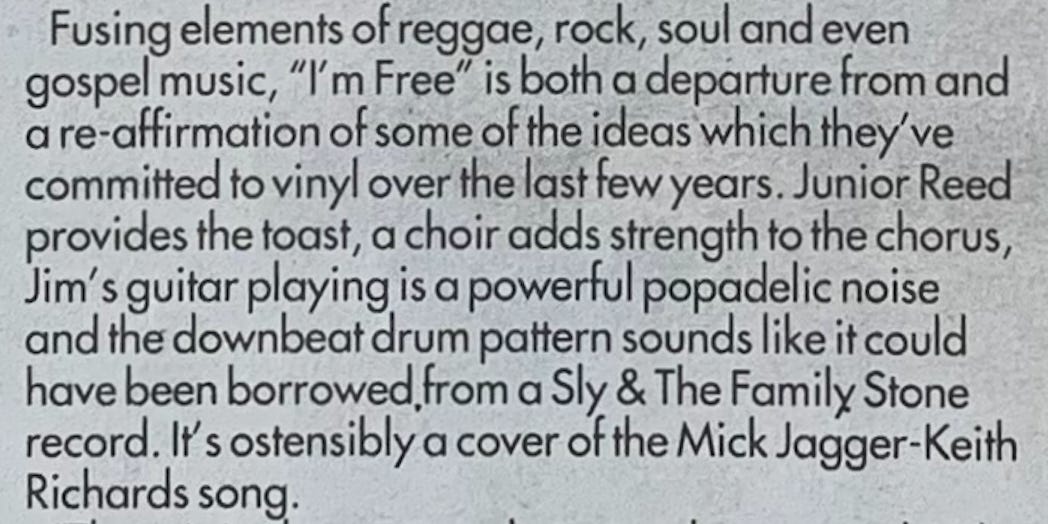
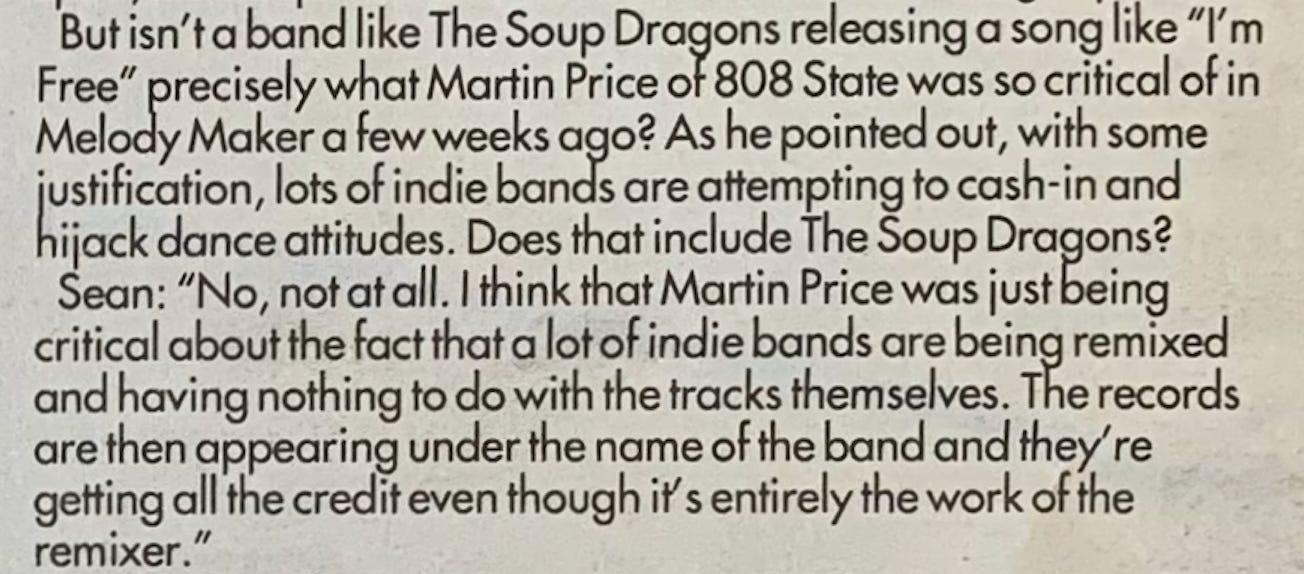
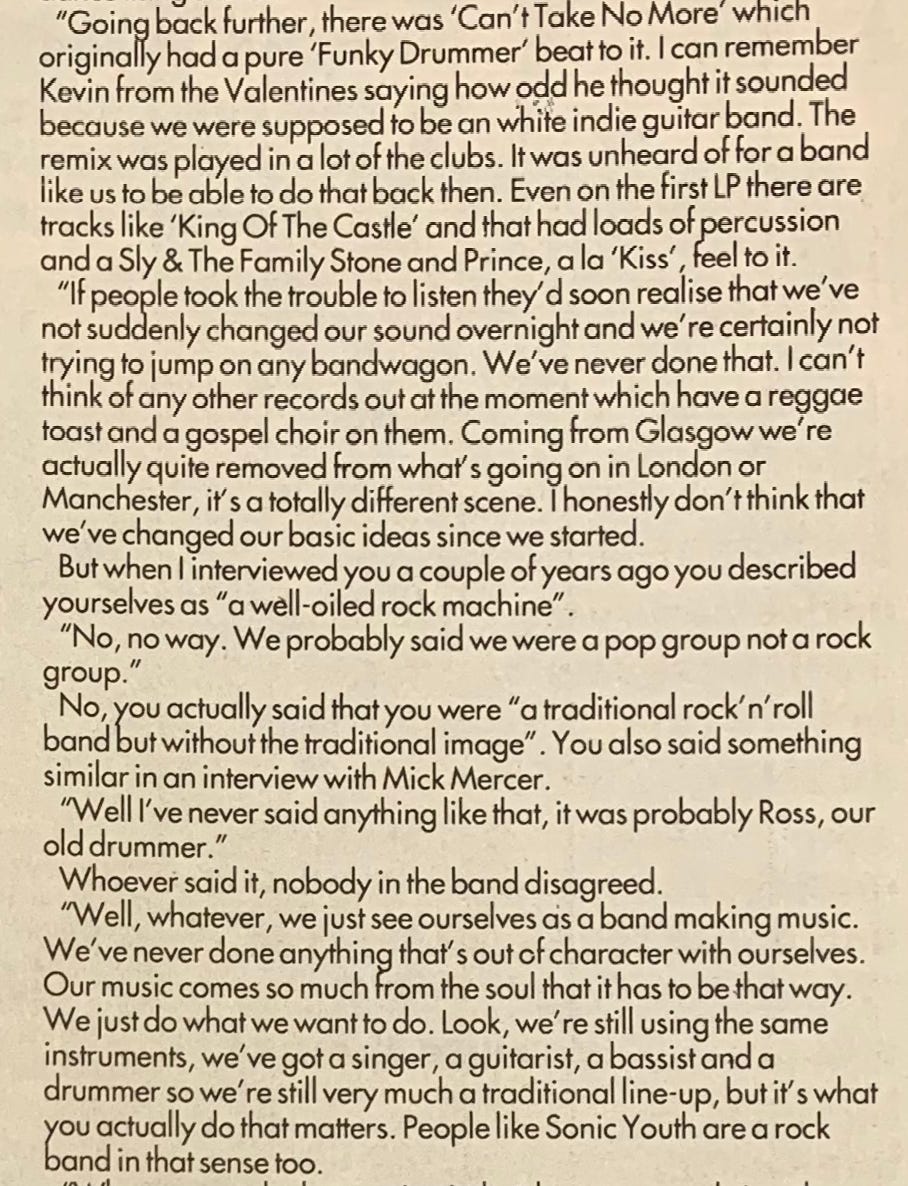
There is a sense that the interviewer was trying to catch the band out, though I think they responded with very valid and robust answers. What is apparent, however, is that this line of questioning does not seem to have stemmed directly from I’m Free itself, but from an earlier Melody Maker interview with 808 State.
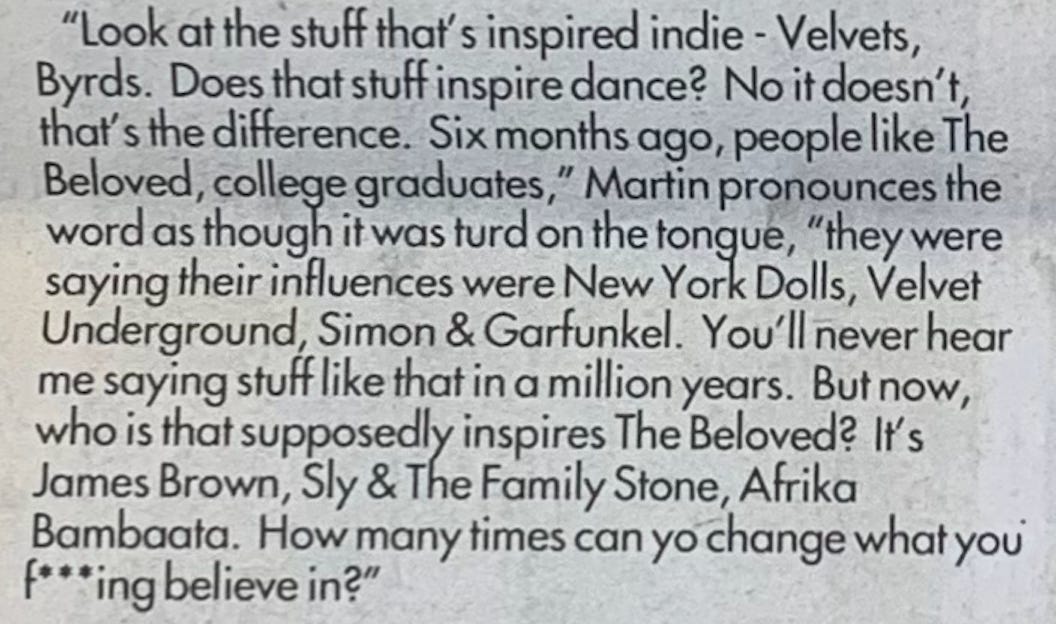
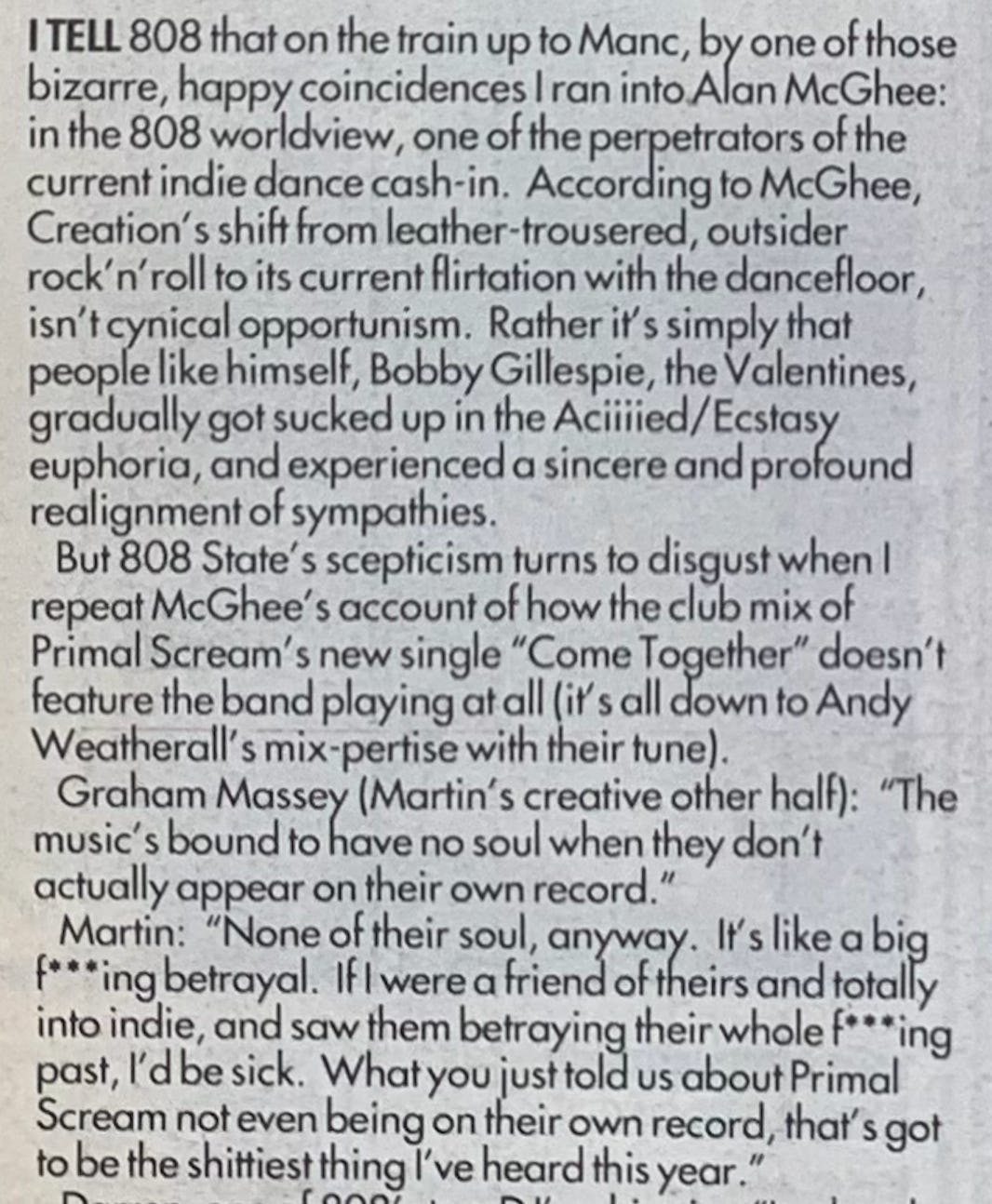
June 30th, 1990. Melody Maker article on 808 State by Simon Reynolds.
There is a strong sense that the band have an axe to grind, and it’s not with The Soup Dragons…
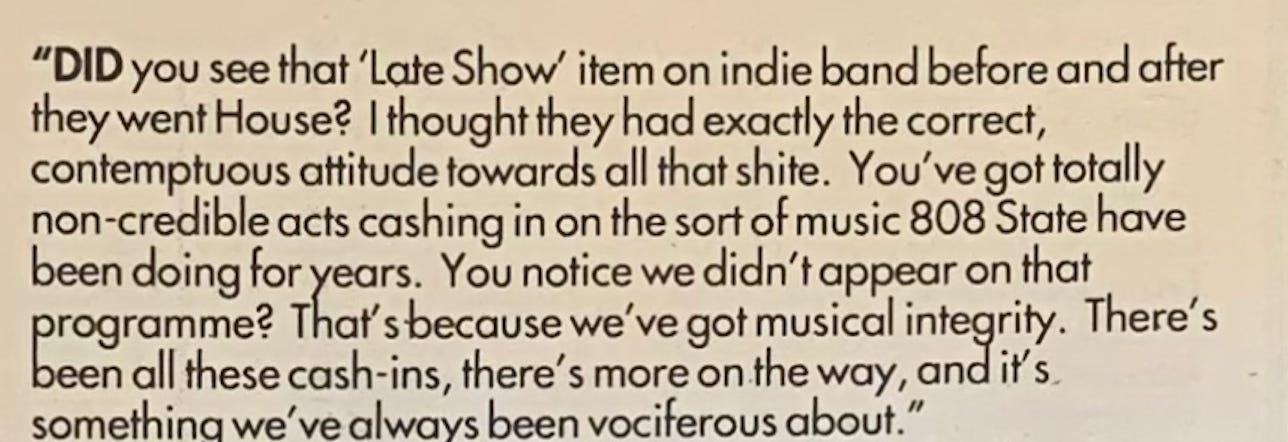
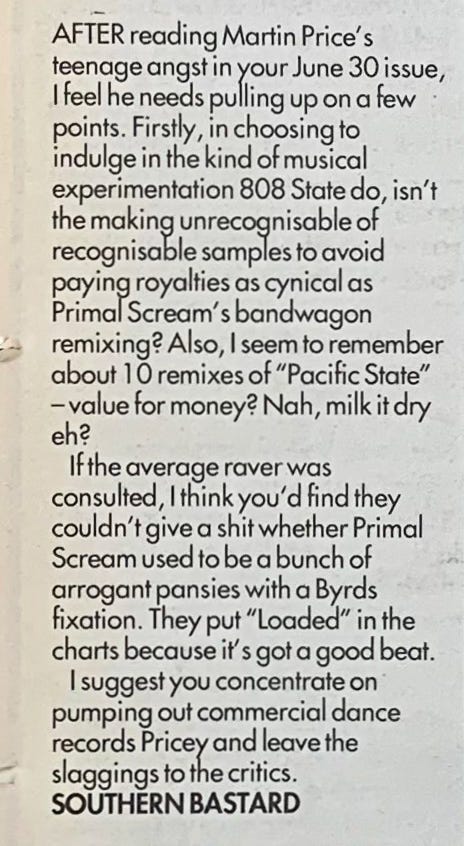
The following week’s edition had a number of reader letters in response, including this one.
Cut To: 2011, John Doran in the NME
“When Primal Scream first released ‘Loaded’ as a single in 1990, it formed a crossroads for thousands of people (myself being one of them), pointing the way from the blissed out and medicated indie rock of the late 1980s by the likes of Spacemen 3, My Bloody Valentine and Loop into the burgeoning realms of rave and ecstasy culture.
But by the time ‘Screamadelica’ was released nearly two years later, it’s hard to describe how ubiquitous not just this song but this entire sound had become due to the efforts of inferior imitating souls. The Soup Dragons (‘I’m Free’), The Farm (‘Groovy Train’) and even Blur (‘She’s So High’) had attempted to inflict the death of a thousand cuts on ‘Loaded’. Even though they only succeeded in making it seem slightly more mundane, pointing out perhaps the relative shuffling insubstantial nature of the Edie Brickell and the New Bohemians loop that underpinned it.”
So, how do we align this apparent change in narrative from contemporaneous accounts? Primal Scream were being accused of bandwagon-jumping in June 1990, yet 20 years later they were being heralded as pioneers, while their contemporaries, whose releases had arrived earlier, were seen as mere followers.
We need to go back to the source again: the music press, to trace the chronology of The Soup Dragons’ relationship with dance music and, for comparative purposes, also Primal Scream’s.
Firstly, though, a music release that combines a Scottish indie guitar band incorporating the sounds of the emerging acid house scene predates both bands. It also predates The Stone Roses, Happy Mondays’ Madchester Rave On EP and the WFL remix.
This record was the “Synergy” promo by The Shamen, released to promote their In Gorbachev We Trust album in December 1988. This, if anything is the ground zero of indie meeting dance with credibility.
But, back to The Soup Dragons and Primal Scream. The Soup Dragons had released This is Our Art, their debut album on Sire in 1988 and Primal Scream released their eponymous rock oriented 2nd LP in 1989. Both bands by now were in a state of semi-crises, losing members and releasing flop albums and losing much of their earlier press-darling status. They would be become targets for a press backlash.
By January 1990 though both would release what was then regarded as indie-dance singles. However, the approach to both would be entirely different.
The Soup Dragons had Mother Universe and Primal Scream had Loaded.
But which came first? A surprising source for accuracy is not the music press or press-releases but the local press who could, in the pre internet era offer daily reviews. Combined with the traditional music-press we can accurately trace the path taken by both bands.
13th January 1990, Shields Daily Gazette.
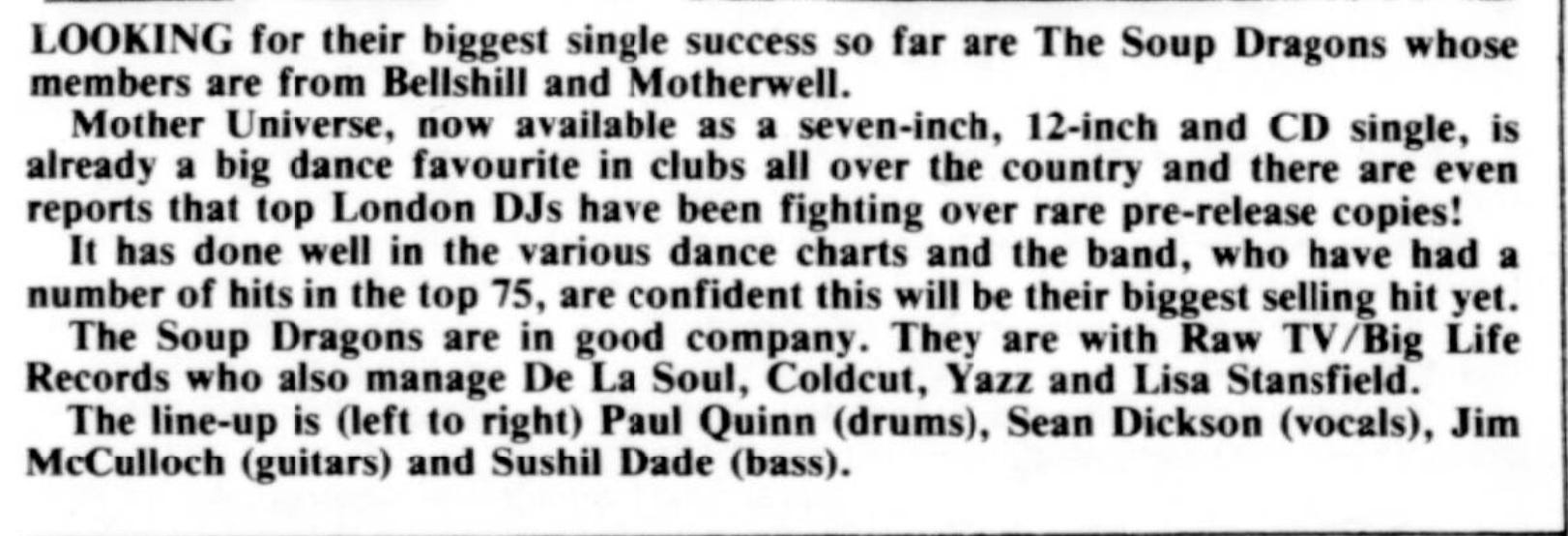
We can see The Soup Dragons had Mother Universe available as a single by the 13th of January 1990.
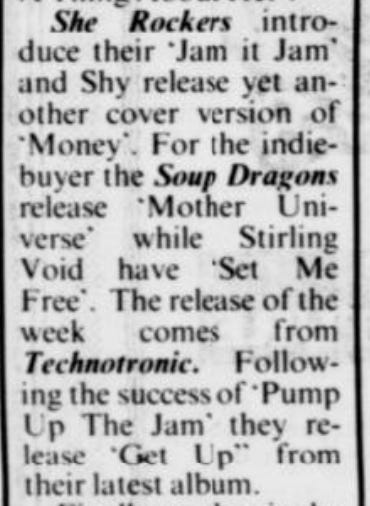
The song had actually been available to DJ’s as a promo in the previous year. I’ve struggled to find a press-release to company this earlier version but there is plenty of historical data to evidence it being created in 1989. This includes a Big Life 1989 production date. While the below preview Motherwell Times article does not specify a date, the context weights it more to 1989 than 1990. It also presents the song as being a hit in the clubs.
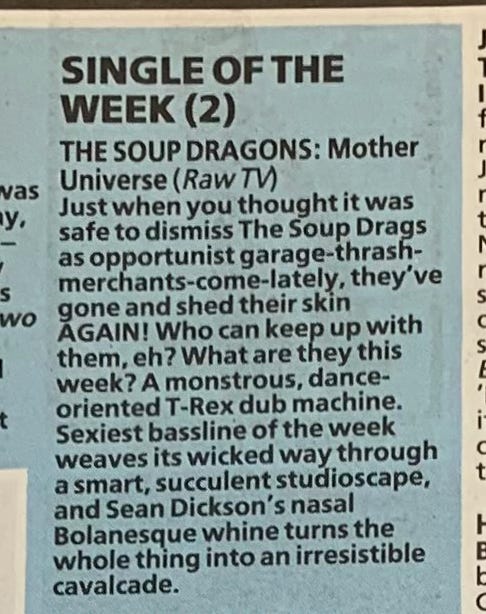
It would not reach the pages of the mainstream music-press until March the 10th though, where it received single of the week in the NME.
But what of Loaded?
Loaded was reviewed in the Melody Maker on the 10th of February and NME on the 17th of February, and is given an 18th of February release date on Discogs.
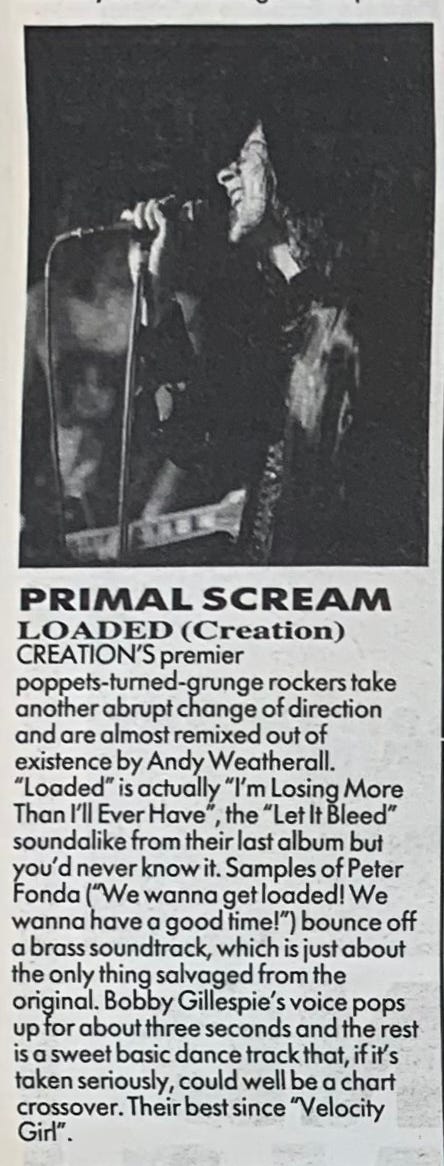
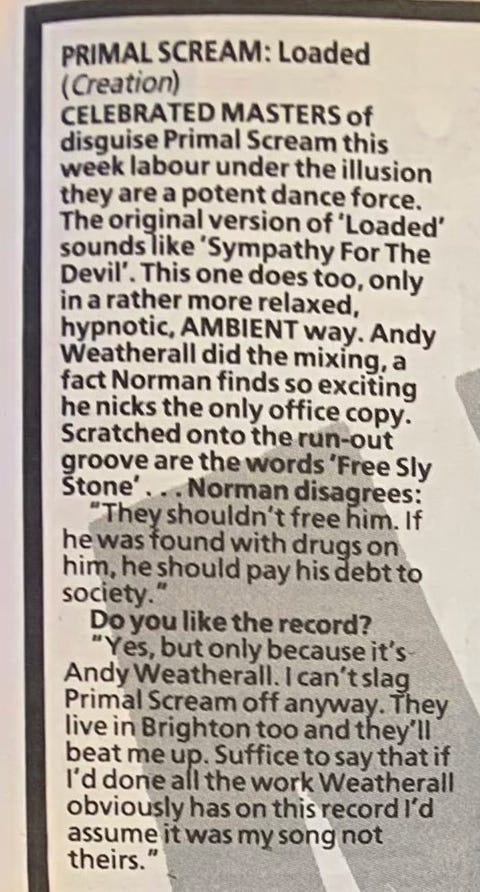
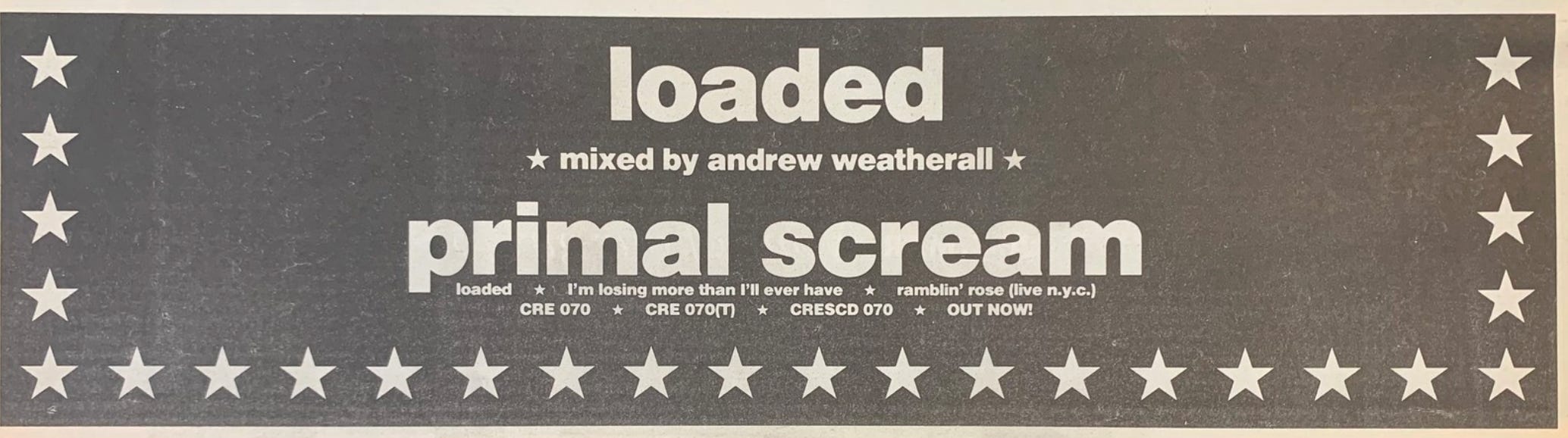
I think, on balance, that with local newspaper coverage of Mother Universe appearing before anything in the NME or Melody Maker, a contemporary timeline showing the promo circulating in clubs, and a Big Life production date of 1989, we can strongly lean towards the conclusion that The Soup Dragons had made a dance-influenced record available to the public before Primal Scream.
But what of the background leading to these two near-contemporaneous, guitar-heavy bands officially releasing dance-influenced singles at roughly the same time? Is there evidence to suggest this was a natural progression or, indeed, an act of bandwagon-jumping? I think it’s clear that while both bands were accused of a series of abrupt direction changes, At this stage, Primal Scream appear to be more of a target for press vitriol.
Let’s take a look at their preceding six months, beginning with Primal Scream.
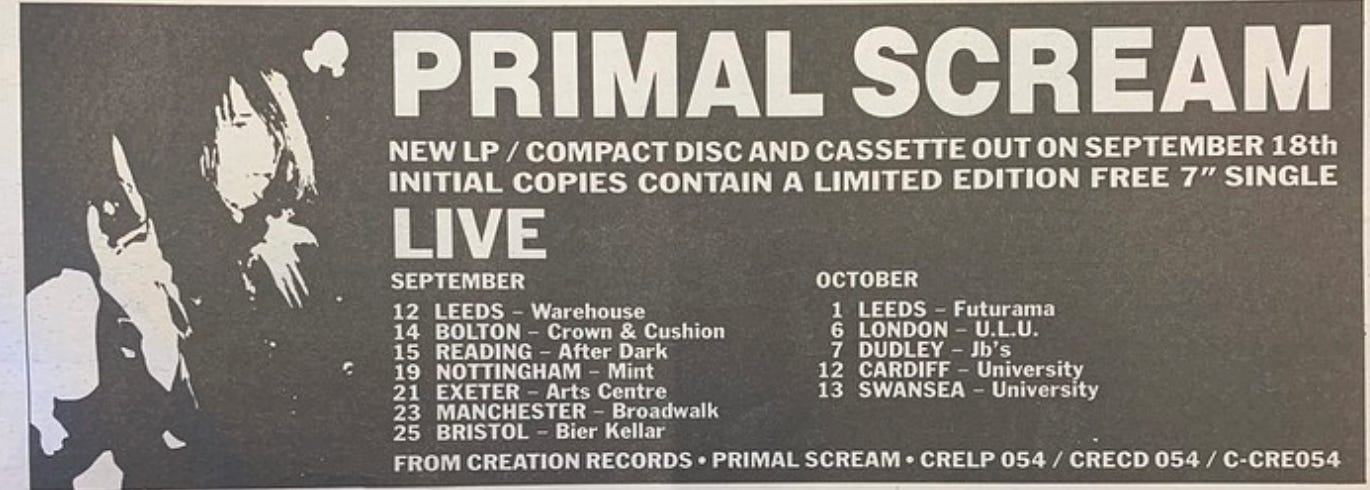
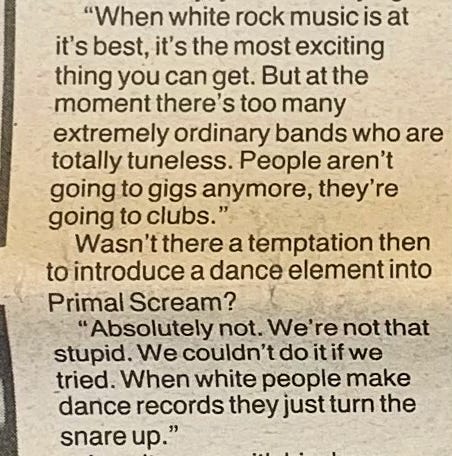
Primal Scream’s second album, Primal Scream was a strong departure from their C86-era debut into hard-rock territory with a strong Stooges and MC5 influence. In an August 1989 interview with the NME’s Stuart Maconie, Bobby Gillespie was quite clear on his views of introducing dance element’s into Primal Scream (and also seemingly forgetting the history of Rock’s black musicians, including Chuck Berry and Little Richard have a pretty strong claim to creating rock music at its most exciting) :
Cut to: 17th February, 6 months later and in an NME article on Loaded we are offered this explanation for the change in their sound:
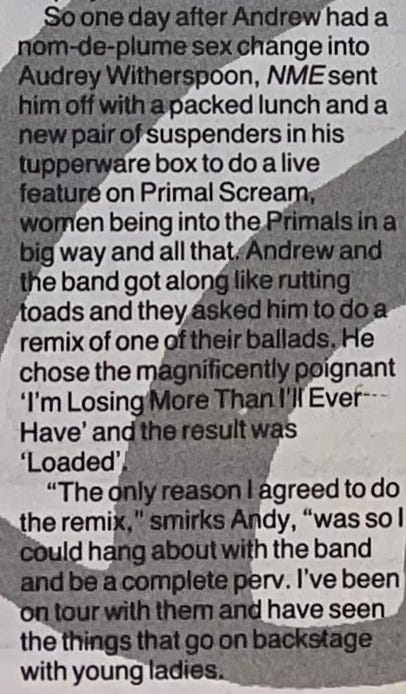
Of course, despite the missing link to Primal Scream’s sudden chage of heart it should need no explanation but if one person was to make a credible and legendary dance-track for Primal Scream it would be Andrew Weatherall.
And The Soup Dragons?
Well, this is where things get interesting. At the beginning of this article we touched upon the record industry loving the opportunity for a sure-fire success. And when The Soup Dragons were the indie-pop darlings of 1986 they were approached by a management team who could see that potential. That management team was Jazz Summers and Tim Parry, who would shortly form the legendary dance label, Big Life, home to The Orb, Coldcut, Yazz, Junior Reed and De La Soul.
The band were initially given their own label, Raw TV before being signed to Sire for their debut album. When this latter release failed to provide the label a hit they were offered an opportunity to officially be on the dance label.
In August 1989 the band were interviewed for Intermission TV to discuss their soon to be released single, Backwards Dog, as well as why they signed to a dance label:
Sean: It’s really good being on Big Life as the bands are so different and I really like them all for what they are, ranging from Coldcut to De La Soul. With De La Soul there’s slight similarities to what we’re trying to do, though not in the dance side of things but because the bands on it are so different we are getting slight influences from them. Like we have been playing about with drum machines and samplers, though we’ve not been doing it in a dance-oriented way.
It would be simple to have just chopped the last part of Sean’s interview and excluded the phrase ‘we’ve not been doing it in a dance-oriented way’. Despite advancing a very credible pre-Mother Universe ‘dance’ narrative, doing so would undermine the integrity of this article.
However, in October 1989 their next single, Crotch Deep Trash, came with a Dub Mix on the B-side. While not strictly a dance track, it certainly combines many of the elements associated with the genre. More importantly, it adds weight to the interview claims about working with drum machines and samplers, and being influenced by the other Big Life acts.
It can realistically be seen as a hugely important link between the rock-oriented material of mid-1989, the pure dance influence of the DJ-only release of Mother Universe in late 1989, and that track’s official release in early 1990.
It also aligns the band with the increasingly prominent dance-oriented releases emerging from Manchester, such as the infamous remixes of Fools Gold by The Stone Roses, the WFL remix by Happy Mondays, and the Madchester Rave On EP in November 1989. Of course, these are not like-for-like examples, given Happy Mondays’ long-standing funk influences and The Stone Roses’ shuffle beat. However, they do provide a wider chronological context for guitar bands formally embracing dance music.
We can also offer an aural development of Mother Universe which does present further evidence for its origin being aligned to having a dance element.
This below October 1989 live show presents one of the earliest incarnations of the song, While it clearly is rooted in rock there’s a very prominent shuffle-beat present that offers a very clear path to the soon to be released DJ promo version, that would see an official release in the earliest days of 1990. It’s not a huge leap.
Here’s the 1989 DJ Promo version:
And here is the re-recorded version which appeared after I’m Free:
Of course, we’ve not yet talked about I’m Free itself, but this chronology provides the necessary background to place it within the releases of the summer of 1990.
When presented within this context, I think it becomes clear that The Soup Dragons were not simply jumping on any ‘indie-dance’ bandwagon, and the same applies to I’m Free.
In fact, until I’m Free became such a phenomenon that summer, The Soup Dragons were not even the primary targets of these accusations. Instead, they were directed at contemporaries, specifically Primal Scream and The Beloved, perhaps as a consequence of the Simon Reynolds 808 State interview. While there were clearly some reservations among fans and journalists about the genre, broadly in the months preceding it, this appears to be where the real seeds of scepticism were sown. Prior to that, the new direction of independent guitar music had generally been received with enthusiasm.
That warmer response makes sense within the broader development of 20th-century popular music, because it has precedent. Looking at David Bowie’s output during the 1970s, there were rarely two consecutive albums that sounded alike; his willingness to move between genres was something to be admired. The same principle underpins the remarkable development of The Beatles throughout the 1960s. It can equally be applied to Miles Davis.
Development, change and the absorption of new influences are central to what makes great pop music. To suggest otherwise seems perverse, elitist and, ultimately, unhealthy for music. 808 State’s interview appears to have a strong undercurrent of jealousy rather than a salient criticism.
But it is fascinating to see contemporary evaluations of Primal Scream’s first dalliances with dance music. Before the huge success of I’m Free, which brought these questions of authenticity and credibility into much sharper focus, those opinions were among the most negative and reactionary. Simply put, many people were not buying the change. However, as we have seen from John Doran’s NME piece in 2011, the perception 21 years later was very different, and in Doran’s case awash with rose tined spectacles and historical innacuracy.
Of course, the release of Screamadelica and the hugely successful process of building its mythology over the following years must have played a significant role. It also helps that it is a genuinely excellent album.
Likewise, Lovegod, released by The Soup Dragons in April 1990, is too an excellent album. Contemporary reviews published before I’m Free demonstrate this clearly. It was pioneering and helped introduce electronic music to new audiences. Most importantly, it was packed with fantastic pop songs, which is ultimately what The Soup Dragons did best.
The two albums share some common DNA, but they are fundamentally different records, pursuing very different goals. Both succeed spectacularly on their own terms. Both are valid and welcome chapters in the story of pop music.
And finally, The Soup Dragons’ I’m Free is one of the great singles of 1990 and, as we have seen, it has endured to the present day. Not only through The Soup Dragons’ version, but through reinterpretations embraced by entirely new audiences and generations.
It is to that story that we now turn for Part Two.
Two – investigate the success of the song to the modern day and determine if the group should perhaps receive greater credit for its modern success
One of the most surprising aspects of The Soup Dragons’ I’m Free is not its 1990 success (because, of course it was never not going to be a big hit) but, unlike the vast majority of other hits from that era it’s what happened to it afterwards.
For a record often unfairly dismissed by the mainstream as little more than a product of the ‘indie-dance’ era,, it has enjoyed an extraordinarily long afterlife. More than thirty years after its July 1990 release it continues to still generate new audiences, new interpretations and, almost certainly, a considerable amount of revenue. And not just for those directly involved in that 1990 recording.
Most people know the broad outline of the song’s history: The Soup Dragons take a relatively obscure Rolling Stones album track (first heard by the band in its 1969 Hyde Park live version) and create one of the freshest British singles of the summer of 1990.
Sean Dickson (interviewed by the author in 2013):
One day, about three or four o’clock in the morning after being out somewhere, I came home and I saw The Rolling Stones ‘Live At Hyde Park’ on the TV. I’d never seen it before. And the next morning we were rehearsing…I said to Jim our guitarist ‘did you see that song I’m Free by The Stones,’ and he was like ‘Yeah, yeah,’ and I was like ‘I’ve never heard that song before,’ and he goes ‘it’s some obscure B-side or something’, I go ‘great song,’ and we literally just started jamming it. And all I could remember was ‘I’m Free, do what I want any old time,’ and if you actually listen to the version The Soup Dragons ‘I’m Free,’ half the lyrics are wrong because I didn’t have the lyrics and I didn’t, we didn’t actually go back to the movie to study it, we just jammed the version of I’m Free. And then a few days later we were in the studio, you know, recording and we decided to do I’m Free. We were just like ‘let’s put 8 minutes of a drum groove down and invent a record on top.’… the bass line is nothing like I’m Free of The Stones, and we just said ‘right, let’s make this section the kind of Jimi Hendrix guitar section,’ then ‘let’s get a Gospel Choir,’ and then we actually looked up Yellow Pages for a Gospel Choir and found one in London. We phoned them up and the next day 35 people came and sang I’m Free. We just made it up as it went over the next few days.
It’s doubtful that even it’s fiercest critics then would have believed its eventual and surprising afterlife. There was a 21 year gap between the last commercially released cover in 1969 by Wilmer and the Dukes and The Soup Dragons. And there was a 27 year gap between The Soup Dragons and the next commercially notable cover.
In 2017, Pitbull released Freedom, a major international hit built around I’m Free. What becomes apparent on even a cursory listen is that the song appears to be built around two principal hooks: the ‘I’m Free’ chorus itself and the distinctive keyboard riff.
One can reasonably argue that, much like The Soup Dragons version before it, the alterations to the chorus melody, metre and lyrics represent a development of the original Rolling Stones composition. However, the resulting sound feels considerably closer to The Soup Dragons than to either the 1965 studio recording or the Hyde Park performance.
The keyboard riff is perhaps more interesting. Unlike the chorus, it is not present in the original Stones recording, nor does it appear in the Hyde Park version which Sean Dickson has often cited as his introduction to the song. Instead, it appears to be unique to The Soup Dragons’ reinterpretation.
This does not prove that those responsible for Freedom were directly influenced by The Soup Dragons. However, it does suggest that the musical lineage may be more complicated than a simple progression from The Rolling Stones to Pitbull.
To my ears, Freedom owes at least as much to the arrangement and production ideas introduced by The Soup Dragons as it does to the original composition itself. The keyboard riff, in particular, stands out as a distinctive and identifiable hook.
It is also a hook to which we will return.
Two years later, Yves Saint Laurent launched its global Libre campaign featuring Dua Lipa, placing the song at the centre of a hugely successful perfume campaign.
Between them, these releases exposed millions of people to I’m Free, many of whom will have had little or no awareness of either The Soup Dragons or, perhaps more surprisingly, the original Rolling Stones recording.
In fact, even those familiar with the Rolling Stones version were likely to know only the 1965 studio recording, originally released as a B-side in the United States and subsequently places on the December’s Children ‘odds and sods collection’, and as an album track on Out of Our Heads in the UK. It is a surprisingly different record to any of the versions that followed.
The Hyde Park performance, while undoubtedly important to Sean Dickson’s own story, had a far more limited public presence. Following its original screening in 1969, it was not commercially available until its VHS release in 1983 and subsequent DVD release in 2001, aside from occasional television broadcasts and limited cinema screenings.
Viewed in that context, there is a strong argument that, for several generations of listeners, The Soup Dragons version became the definitive version of I’m Free. Certainly, it is the version that appears to have exerted the greatest influence on the song’s subsequent commercial life.
This immediately presents an interesting question.
If a song written by Mick Jagger and Keith Richards in 1965 is still generating significant commercial value in the twenty-first century, where exactly does that value lie? It is here that the story becomes rather more complicated.
Because when one listens to the later versions of I’m Free, many of the identifiable characteristics seem to originate with The Soup Dragons version rather than the original. Whether that observation has any legal significance is a question for others. What is beyond dispute, however, is that it raises a fascinating historical one.
The credits are Jagger/Richards (arranged by Sean DIckson)
Sean Dickson:
We never made any money out of I’m Free because we were not given a percentage on it… it’s not actually 100% their song because there’s a 1 and a half minute section in the middle with a guy doing a rap, which has got nothing to do with your record. But we didn’t realise that that record was going to go and sell millions of copies. We just said ‘ok, put it out’.
The credits to Freedom by Pitbull are: Pérez (Pitbull), Jagger, Richards, Richard Pearl (producer).
When Pitbull released Freedom, a single built around I’m Free it was featured prominently in the soundtrack to Ferdinand. The song became an international hit and introduced the composition to a new generation of listeners.
Listening to Freedom alongside the original Rolling Stones recording reveals an obvious lineage. Listening to it alongside The Soup Dragons version reveals something even more striking. To me, many of the musical choices appear far closer to the 1990 arrangement than the 1965 original.
This is not to suggest that Pitbull sampled The Soup Dragons recording directly (it clearly does not). Nor is it to claim that any copyright infringement took place. Rather, it is to observe that the version of I’m Free being reintroduced to a twenty-first century audience appears to owe a significant debt to the musical reinvention created by Sean Dickson and his band.
Some similar observation are more difficult to be made regarding the Yves Saint Laurent Libre campaign. But it should be clear that both Dua Lipa and Yves Saint Laurent Libre are major brands and artists.
When one begins to examine how the music industry has historically treated distinctive musical contributions that fall somewhere between songwriting and arrangement, the answers become considerably less straightforward. Like, when does an arrangement become an idea?
At first glance, the answer appears straightforward.
The Rolling Stones wrote I’m Free. Mick Jagger and Keith Richards are credited as its songwriters and every subsequent version ultimately derives from that original composition under traditional understandings of copyright. Traditional music copyright has for a long time been defined by a songs chords, vocal melody and lyrics, and it is clear that the elements in the 1990 Soup Dragons version all adhere when quantified by this understanding.
However, the history of popular music is littered with examples that suggest the reality is often more complicated. This is particularly true when a musical contribution sits somewhere between composition and arrangement. A distinctive instrumental hook, production idea or musical motif may not alter the underlying chords, lyrics or melody, yet can become central to how audiences identify a song. In some cases, those contributions become so significant that they eventually raise uncomfortable questions about authorship, ownership and value.
One of the most interesting examples comes from Scotland (sorry for bringing this up, Bobby). In 1983, Bananarama released Young At Heart, a song written by Bobby Bluebell and Siobhan Fahey. This record failed to seriously trouble the charts. In 1984, Bobby’s band, The Bluebells revived the song and it reached the UK top ten. However, after it was used in a Volkswagen advertising campaign, 9 years later it subsequently reached number one in the UK.
For many listeners, a defining element of The Bluebells’ version was the distinctive violin line performed by session musician Bobby Valentino. Valentino did not received a songwriting credit for this contribution, as was the standard practice.
Years later though, he successfully argued that his contribution went beyond mere performance and represented a significant compositional element of the finished work. The courts agreed and he was awarded a share of the songwriting royalties. Whether one agrees with that judgement or not is beside the point.
What matters is that this established an important principle. A contribution need not consist of lyrics or a vocal melody to be considered creatively significant. Nor, indeed, must it come from one of the credited songwriters. In some cases, an idea introduced during the recording process can become inseparable from the identity of the finished record.
This question would arise again with a similar but different context during the 1990s. In 1997, The Verve released Bitter Sweet Symphony, a defining British singles of the Brit-Pop era. The song famously sampled an orchestral recording of The Rolling Stones’ The Last Time created by Andrew Loog Oldham, their then manager, and a recording controlled passed by him to ABKCO (who also control I’m Free). What followed became one of the most notorious copyright disputes in popular music history.
The legal arguments themselves are well known and need not be repeated in detail here. What is relevant is the outcome because despite Richard Ashcroft writing the song itself, ownership of the composition became heavily disputed due to the sampled material. For years the songwriting credit was fiemly Jagger/Richards. Only in 2019 did ABKCO, Mick Jagger and Keith Richards agree to return their songwriting credits to Ashcroft
The Verve case differs substantially from The Soup Dragons’ I’m Free because it involved a direct sample and therefore a clearly identifiable piece of protected audio. Yet it remains relevant because it demonstrates the extraordinary commercial importance that can attach to relatively small pieces of music.
This does bring in other complications.
In 2013, Robin Thicke and Pharrell Williams released Blurred Lines, a global hit which would eventually become the subject of another of the most controversial copyright cases in modern music, possibly even surpassing The Verve.
The Marvin Gaye estate argued that the song infringed upon elements of Got To Give It Up. Critics of the case pointed out that the songs shared no identical melody, no shared lyrics and no shared chord structure. The estate argued that it was the overall musical feel and style that violated the copyright and the court ultimately sided with the Gaye estate. The judgement sent shockwaves through the music industry. While the circumstances are very different to those surrounding I’m Free, the case illustrates just how far the debate has moved beyond the traditional understanding of copyright as merely chords, melody and lyrics.
Which brings us back to I’m Free.
The issue here is not whether Sean Dickson wrote the song. He didn’t and I’m not disputing this.
The more interesting question is whether elements introduced by The Soup Dragons became integral to the song’s modern identity. Much like the Bobby Valentino case, one can reasonably ask whether ideas added during the recording process can become so closely associated with a song that they take on a significance beyond mere arrangement.
I think it is entirely arguable that, were The Soup Dragons version released today, the credits would be more reflective of modern practice, where producers, arrangers and additional writers are routinely credited for contributions that transform a composition into something substantially different from its original form. And that is why Sean Dickson’s recollection of the recording process is so interesting. Whether one agrees with the implications or not, it is difficult to ignore the possibility that some of the elements which later audiences responded to most strongly were not present in the original composition at all.
Because when audiences encounter I’m Free through Pitbull’s Freedom, through the Yves Saint Laurent Libre campaign, or through any number of subsequent reinterpretations, they are not necessarily encountering the song as it existed in 1965.
The original Rolling Stones recording of I’m Free was released in September 1965. It is unmistakably a product of its era. Built around acoustic guitar, tambourine, vocal harmonies and a relatively sparse arrangement, the song’s appeal lies in its melody and its sense of youthful optimism. It is an excellent pop song, but there is little in the recording that would suggest its future as a dancefloor anthem.
The same is largely true of the version performed by the band at Hyde Park in 1969. This performance is particularly important because Sean Dickson has frequently identified it as his introduction to the song. Yet while the arrangement is expanded and more forceful than the original studio version, many of the elements later associated with The Soup Dragons recording remain absent. There is no electronic keyboard hook, no sampled textures, no contemporary dance production, no rap/toast (Junior Reid’s contribution immediately transforms the song’s dynamic), and most importantly, there is little indication of the rhythmic emphasis that would later become central to the song’s commercial rebirth.
For more than twenty years, this was essentially the song that existed in the public imagination. Whether consciously or otherwise, it is this version that appears to establish the template through which later generations would encounter the song.
Nobody would confuse Freedom with either the Rolling Stones recording or The Soup Dragons single. It is very much a product of twenty-first century commercial pop. However, when listening across the chronology of the song, the lineage appears difficult to ignore and debt is not simply to the Jagger/Richards composition itself. Rather, many of the musical decisions seem to draw from a version of I’m Free already filtered through The Soup Dragons’ reinterpretation.
An interesting further postscript is Oasis. While it is a different argument there is one mid 90s observation of note relating to I’m Free.
In December 1994, Oasis released Whatever, one of the defining singles of the pre-Britpop era. The song opens with the line “I’m free to be whatever I choose” before later declaring “I’ll sing the blues if I want”. The Soup Dragons’ version of I’m Free had introduced the lyric “I’m free to be who I choose / To get my blues any old time”. Whether coincidence or influence, the similarities are difficult to ignore.
 Year Zero